
ApeX vs Hyperliquid: compare the right costs
Reviewed 2026-09-18 · Affiliate Code Research
Evidence, methods and test limits
At the documented base rates reviewed on 18 September 2026, ApeX Omni charges 0.02% maker and 0.05% taker. Hyperliquid’s standard validator-operated perpetuals use 0.015% maker and 0.045% taker. These baselines do not capture every account adjustment, market type or execution cost.
The useful comparison is the cost and risk of the same intended trade. This guide has not measured simultaneous order books or completed trading journeys on either venue. The site may earn commission through its ApeX invitation.
Key takeaways
- Hyperliquid’s standard base trading fees are lower than ApeX’s published base fees.
- We cannot establish an ApeX after-referral fee from the public save20 invitation alone.
- Hyperliquid includes non-crypto markets through HIP-3; it is not crypto-only.
- Both venues have more onboarding options than a wallet-only comparison suggests.
- Volume is not a substitute for measured spread, depth and slippage.
Base perpetual fees at a glance
Compare the same fee category before applying account-specific adjustments. The Hyperliquid values below refer to standard validator-operated perpetuals; builder-deployed HIP-3 markets can use different fee arrangements. Check the exact market’s fee before treating these as universal rates.
Sources: ApeX Omni: trading and funding fees · Hyperliquid: fee schedule
| Trading-fee item | ApeX Omni | Hyperliquid standard perps |
|---|---|---|
| Maker | 0.02% | 0.015% |
| Taker | 0.05% | 0.045% |
| Base taker fee on $100,000 total volume | $50 | $45 |
| Base maker fee on $100,000 total volume | $20 | $15 |
Referral terms require separate comparisons
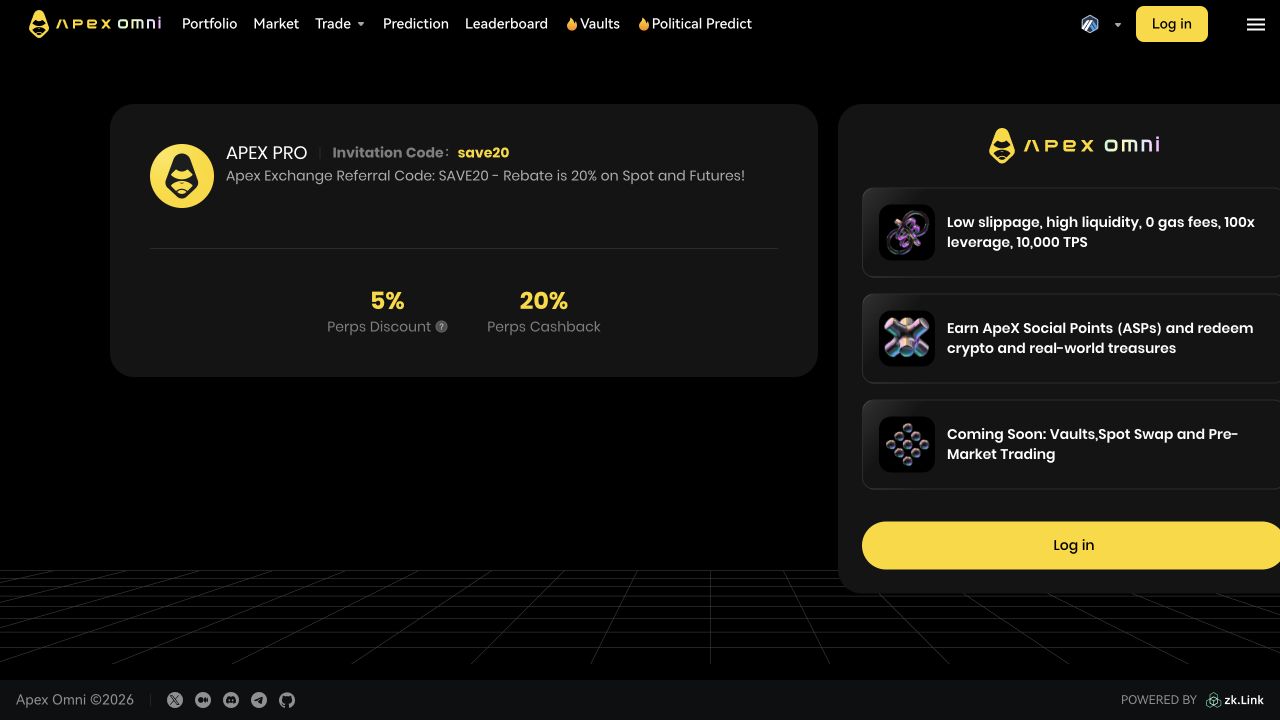
The public save20 invitation observed on 18 September 2026 showed 5% Perps Discount and 20% Perps Cashback as separate fields. It also contained legacy product labels. This does not establish the effective fee or cashback benefit assigned to a new account.
We have not verified the cashback recipient, calculation basis, eligibility or payment timing. Do not add the two displayed percentages together. Confirm the assigned fee and any cashback terms in your account or with ApeX support before relying on them.
Hyperliquid’s referral documentation specifies a 4% fee discount on a referred user’s first $25 million of volume, with exclusions including vaults and subaccounts. That documented program still needs to be read alongside market and account eligibility. It should not be compared with an assumed ApeX net rate.
On ApeX, eligible referral and VIP discounts do not stack under the published VIP rules. Compare the actual assigned account rate on each venue rather than adding every advertised adjustment together.
Sources: Public save20 invitation (affiliate link) · Invitation screenshot observed 18 September 2026 · Hyperliquid: referral rules · ApeX Omni: VIP rules
Liquidity: measure the intended order
Reported trading volume cannot tell you exactly how much liquidity is available at your limit price. A venue with higher aggregate volume may still have a worse quote for a particular market, side, size or moment.
A meaningful comparison records contemporaneous order-book snapshots for the same pair and notional, then calculates spread, available depth and expected slippage. It should include timestamps, matching units, data gaps and the difference between estimated and realized fills. No such experiment has been completed for this guide.
For now, no claim is made that one venue consistently gives deeper books or better execution. Add trading fees, expected funding and transfer costs to the execution comparison before drawing a conclusion.
Markets: Hyperliquid is not crypto-only
Hyperliquid’s HIP-3 ecosystem includes builder-deployed markets. XYZ’s own documentation lists markets involving equities, indices or ETFs and commodities. It is therefore inaccurate to present non-crypto exposure as an ApeX-exclusive feature.
A market’s name does not establish ownership of the underlying asset or identical trading hours, oracle behavior, funding and leverage limits. Read the specific contract rules on each venue. HIP-3 market fees can also differ from the standard-perps baseline above.
Sources: XYZ: HIP-3 markets documentation · Hyperliquid: fee schedule
Onboarding, collateral and account access
Hyperliquid’s onboarding documentation includes email access and multiple deposit routes. An Arbitrum bridge is one documented path, not evidence that every user must follow the same wallet-only journey.
For ApeX, distinguish deposits into the Funding Account from transfers into product trading accounts. The supported route depends on the account setup, asset and network. On both venues, inspect the current deposit and withdrawal flow rather than assuming a network list implies equivalent settlement.
Check applicable terms and geographic eligibility separately. A referral link does not remove access restrictions.
Sources: Hyperliquid: how to start trading · ApeX Omni: deposits and account transfers · ApeX: terms of use
Risk and the decision that remains
ApeX’s official custody and withdrawal descriptions should be read alongside L2BEAT’s deployed-system analysis, which identifies operator and upgrade dependencies. This guide does not infer a safety ranking between venues from marketing descriptions of their architecture.
A decision needs the actual account fee, the intended market, a measured execution comparison, transfer requirements and a risk review appropriate to each deployment. Based on the evidence here, Hyperliquid has the lower standard base fee; a universal lowest-total-cost or safest-venue conclusion is not established.
Sources: L2BEAT: ApeX Omni deployed-system risk analysis · ApeX Omni: force-withdrawal procedure · Hyperliquid: fee schedule · ApeX Omni: trading and funding fees
Frequently asked questions
Which has lower base perpetual trading fees?
For the documented standard base schedules, Hyperliquid is 0.015% maker and 0.045% taker versus ApeX Omni at 0.02% and 0.05%. HIP-3 market arrangements and account adjustments can differ.
Does save20 make ApeX cheaper?
That is not established here. The public invitation separates discount and cashback, and the effective account benefit has not been verified.
Does Hyperliquid only offer crypto markets?
No. HIP-3 operators such as XYZ provide markets involving equities, indices or ETFs and commodities. Check each contract’s specifications.
Does higher exchange volume prove better fills?
No. Compare contemporaneous spread, depth and slippage for the same market, size and side. This guide has not performed that experiment.
Is either venue declared safer in this guide?
No. A safety ranking requires deployment-specific evidence and an explicit methodology. Fee comparisons and referral offers do not establish safety.
Sources
- ApeX Omni: trading and funding fees
- Hyperliquid: fee schedule
- Public save20 invitation (affiliate link)
- Invitation screenshot observed 18 September 2026
- Hyperliquid: referral rules
- ApeX Omni: VIP rules
- XYZ: HIP-3 markets documentation
- Hyperliquid: how to start trading
- ApeX Omni: deposits and account transfers
- ApeX: terms of use
- L2BEAT: ApeX Omni deployed-system risk analysis
- ApeX Omni: force-withdrawal procedure
Check the save20 invitation
Review the public invitation and confirm your account terms. We may earn a commission if you sign up through our referral link and trade.
View ApeX invitation