
ApeX Omni fees explained
Reviewed 2026-09-18 · Affiliate Code Research
Evidence, methods and test limits
ApeX Omni publishes base perpetual trading fees of 0.02% maker and 0.05% taker. Fees apply to executed notional, not the margin used to open the position. Opening and closing are separate fills, so both contribute to your fee bill.
This guide separates published fees from unverified referral benefits. It is based on documentation and a public invitation review, not a completed account-level trading or cashback test.
Key takeaways
- Base trading fees: 0.02% maker and 0.05% taker before any applicable account adjustments.
- A $100,000 total taker volume example produces $50 in base trading fees.
- Funding and transfer costs are separate from the trading-fee calculation.
- ApeX’s VIP rules do not allow stacking eligible referral and VIP discounts.
- Spot Swap closed on 5 August 2026; old swap-fee examples are not current offers.
Maker and taker: the liquidity role matters
A maker fill adds liquidity to the order book; a taker fill removes it. A resting limit order may earn the maker classification, but a limit order that immediately matches an existing order can be a taker. Do not select the maker rate merely because you entered a limit price.
ApeX’s published base schedule charges 0.02% maker and 0.05% taker. Your account’s actual rate can differ under eligible programs. Check the fee displayed in the account and the fee charged on a completed fill instead of inferring it from an invitation code.
Sources: ApeX Omni: trading and funding fees
Worked examples: include opening and closing volume
At the base rate, $100,000 × 0.05% = $50 for taker fills. The same executed notional at 0.02% costs $20 for maker fills. Split the volume evenly and the illustration becomes $10 in maker fees plus $25 in taker fees, for $35 total.
Opening a $50,000 position and closing $50,000 of notional creates $100,000 in total volume. If the closing price changes, so does that fill’s notional. Margin and leverage affect how much capital supports a position; fees are still calculated on the executed volume.
These examples exclude spread, slippage, funding and transfers. The calculator on this site uses the same base schedule and deliberately makes no assumed referral deduction.
Sources: ApeX Omni: trading and funding fees
VIP tiers and referral discounts do not stack
The official VIP schedule offers lower maker/taker rates subject to its volume or staking qualifications. Eligibility and the applicable rate must be checked for the account and review period.
ApeX documents that referral discounts and VIP discounts do not stack; the lowest eligible fee applies. Its VIP rules also say referrer commissions stop for VIP level 2 and above. A commission rule for the publisher is not a statement of the trader’s net discount.
Sources: ApeX Omni: VIP rules
What save20 does and does not prove
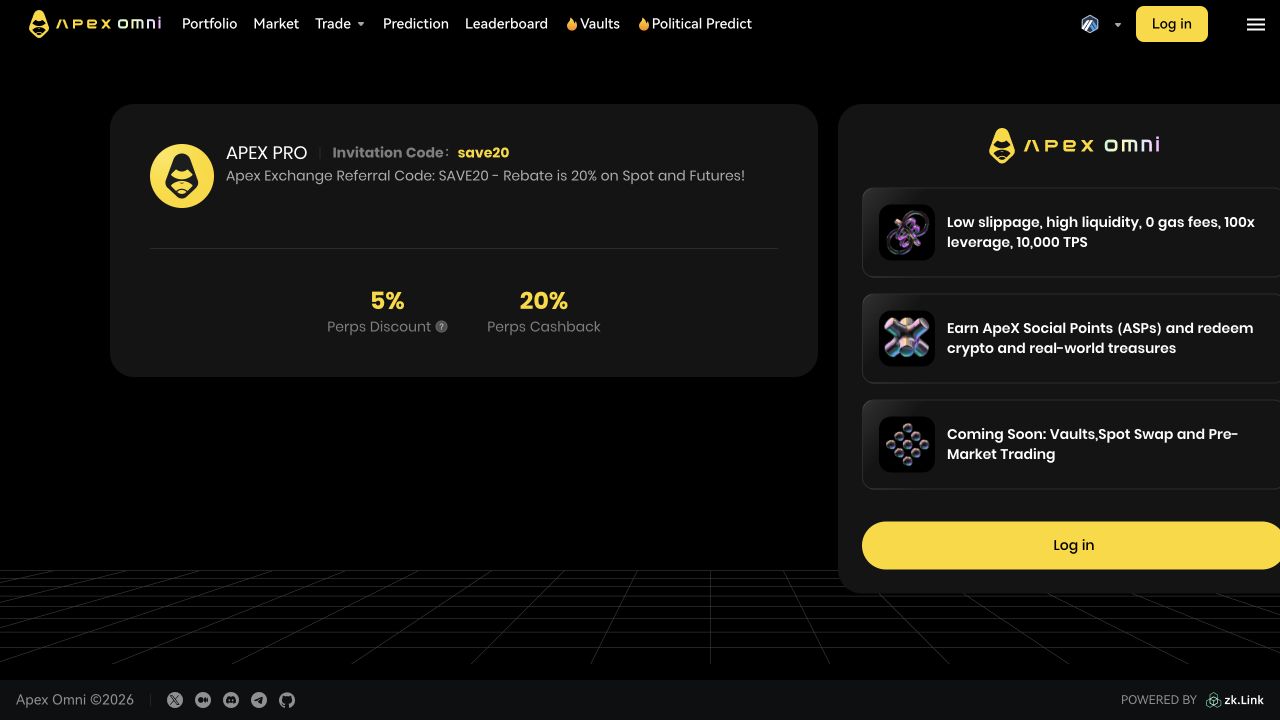
The public save20 invitation observed on 18 September 2026 showed 5% Perps Discount and 20% Perps Cashback as separate fields. It also contained legacy product labels. This does not establish the effective fee or cashback benefit assigned to a new account.
We have not verified the cashback recipient, calculation basis, eligibility or payment timing. Do not add the two displayed percentages together. Confirm the assigned fee and any cashback terms in your account or with ApeX support before relying on them.
We therefore do not publish an effective maker/taker rate for save20. Once an account-level benefit is documented, a worked saving can be calculated against the relevant baseline without assuming that cashback is immediate or unconditional.
Sources: Public save20 invitation (affiliate link) · Invitation screenshot observed 18 September 2026 · ApeX Omni: VIP rules
Funding, deposits and withdrawals
Funding is a separate periodic payment mechanism between long and short positions. Its direction and size depend on the applicable funding rate and position. The trading-fee calculator does not forecast funding or assume that a referral changes it.
Deposit and withdrawal routes can add network or service costs. ApeX’s deposit documentation distinguishes the Funding Account from product trading accounts; a deposit may need an internal transfer before it can support a position.
Check the current app for the supported asset, chain, amount, route, fee and estimated withdrawal time. Do not treat a documented example of a fast or normal withdrawal as a guarantee for every chain or market condition.
Sources: ApeX Omni: trading and funding fees · ApeX Omni: deposits and account transfers
Spot Swap is closed
ApeX’s Spot Swap documentation states that the service closed on 5 August 2026 at 10:00 UTC. Historical swap fees and spot-referral discounts should not be presented as benefits available today.
Legacy spot wording on an invitation is another reason to verify current product-specific terms instead of assuming all displayed campaigns remain usable.
Sources: ApeX: Spot Swap closure notice
Frequently asked questions
What are the base ApeX Omni trading fees?
The published base schedule is 0.02% maker and 0.05% taker on executed notional. Your account may qualify for another applicable rate.
Does save20 establish a particular effective fee?
No account-level rate has been verified here. The public invitation displays discount and cashback separately; this is not sufficient evidence to calculate a guaranteed net saving.
How much are base fees on $100,000 of taker volume?
$50, calculated as $100,000 × 0.05%. Include both opening and closing fills in your total volume.
Do referral and VIP discounts stack?
The official VIP documentation says they do not stack; the lowest applicable fee is used.
Is Spot Swap still available?
The official documentation says Spot Swap closed on 5 August 2026 at 10:00 UTC. Old swap-fee and referral examples are historical.
Sources
Check the save20 invitation
Review the public invitation and confirm your account terms. We may earn a commission if you sign up through our referral link and trade.
View ApeX invitation